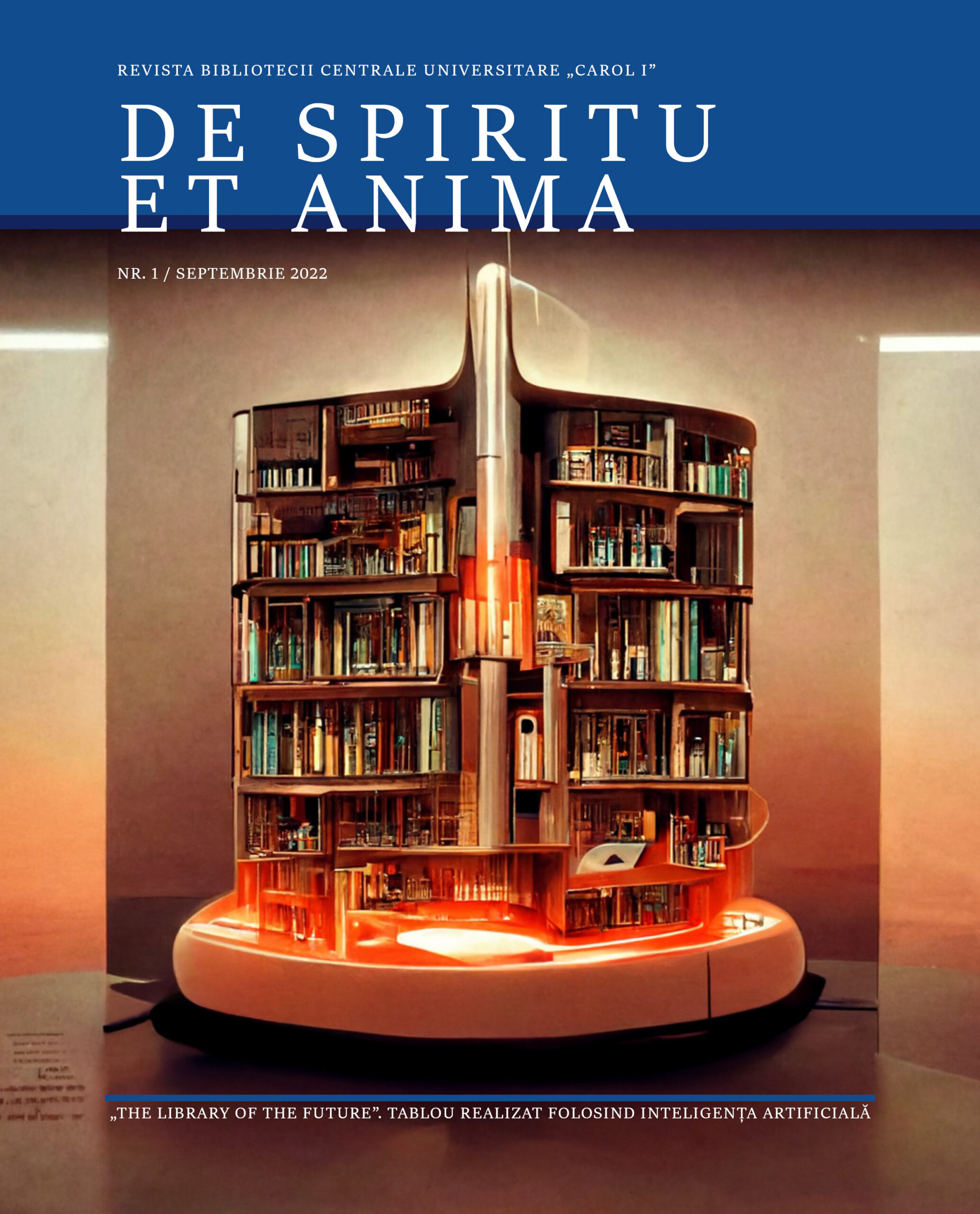
The Kingdom of Romania’s entry into the First World War in the summer of 1916, siding with the Entente, created the opportunity for reclaiming its territories that had been contested for centuries between the neighbouring empires. This goal was possible at the end of the world conflict, as the Austro-Hungarian Empire, the Ottoman Empire, the Russian Empire, and the German Empire ceased to be geopolitical actors on the world map. On their smouldering remains, new nation-states arose that acted to preserve the new world order, being recognised through the peace treaties signed in Paris.
The two antagonistic blocs – the Central Powers (Mittelmächte) and the Entente – sought to attract as many allies as possible to their side, and Romania was no exception in this regard. Initially, the German Empire and Austria-Hungary signed a treaty in 1879, intended to isolate France within Europe, and three years later Italy had joined the alliance as well. This political-military bloc marked the geopolitical balance in Central Europe and beyond. The Ottoman Empire, led by Sultan Mehmed V (1909-1918), also joined them in November 1914[1], as well as the Kingdom of Bulgaria, ruled by Tsar Ferdinand I (1908-1918), in September 1915. Italy would eventually side with the Entente in the spring of 1915, after the signing of the Treaty of London.
The Kingdom of Romania joined this alliance on 30 October 1883, as a result of the geopolitical uncertainty generated by the Russian Empire’s expansionist policy toward the Danube Mouths. This treaty was secret and offered security guarantees to Romania, being renewed in 1892, 1896, 1902, and 1913. Its defensive nature contributed to stabilising the balance of power in the region and to overcoming diplomatic isolation, but the Romanian state was forced to limit its support actions in favour of the Romanian population in Transylvania.
The assassination of Franz Ferdinand, heir to the Austro-Hungarian crown, in June 1914, tragically marked the fate of the European continent. It was the beginning of a conflict that would last four years with loss of life and material destruction on a scale that no one could have foreseen.
The Bucharest government decided to adopt a neutral position towards the ongoing conflict since the Austro-Hungarian Empire had attacked Serbia, which had been accused of being responsible for the infamous assassination. This situation led the decision-makers in Romania to consider the obligations stipulated in the treaty signed with the Triple Alliance nullified and to draw closer to the Entente, the antagonistic political-military bloc.[2]
After two years of neutrality and strong diplomatic pressure, the Kingdom of Romania entered the war on the side of France, England, and Russia, following the decision of the Crown Council at Sinaia in August 1916. Bucharest’s main objective was to complete national unity by freeing the territories inhabited mostly by Romanians.
Romania’s war effort focused on the liberation of Transylvania, but after a while, the strategic initiative belonged to the Austro-Hungarian troops supported by the Germans, and the Romanian forces had to retreat. Two years of heavy fighting to defend the national identity followed, with great human and material sacrifices.
A moment of sad recollection in the public consciousness of those times was the fall of Bucharest into the hands of the Central Powers. This was a disastrous outcome due to the successive defeats suffered by an insufficiently prepared Romanian army in the gruelling battles in Dobruja and Wallachia.
The occupation of the capital took place on 23 November / 6 December 1916, around noon, when troops commanded by General Erich von Falkenhayn entered the city through Calea Griviţei. The mayor, Emil Petrescu, surrendered the city, and shortly after, Field Marshal August von Mackensen issued a proclamation addressed to the inhabitants, in Romanian and German, announcing that: “The city of Bucharest is occupied by my troops, and is subject to the laws of war.” Later, the Germans staged an impressive military parade on Calea Victoriei, on Bulevardul Elisabeta, and on Bulevardul Academiei, in which units of the Allied states also took part.[3]
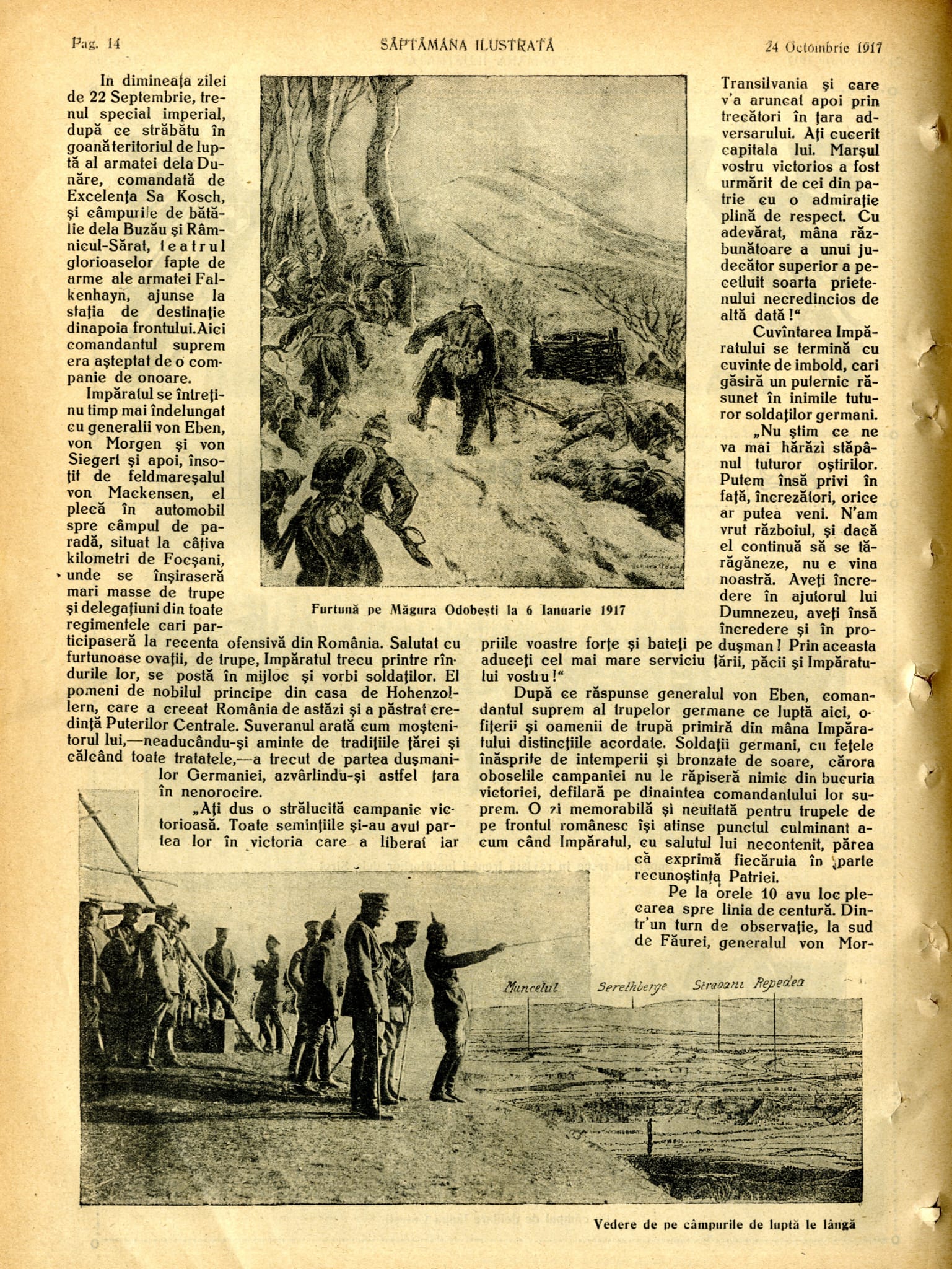
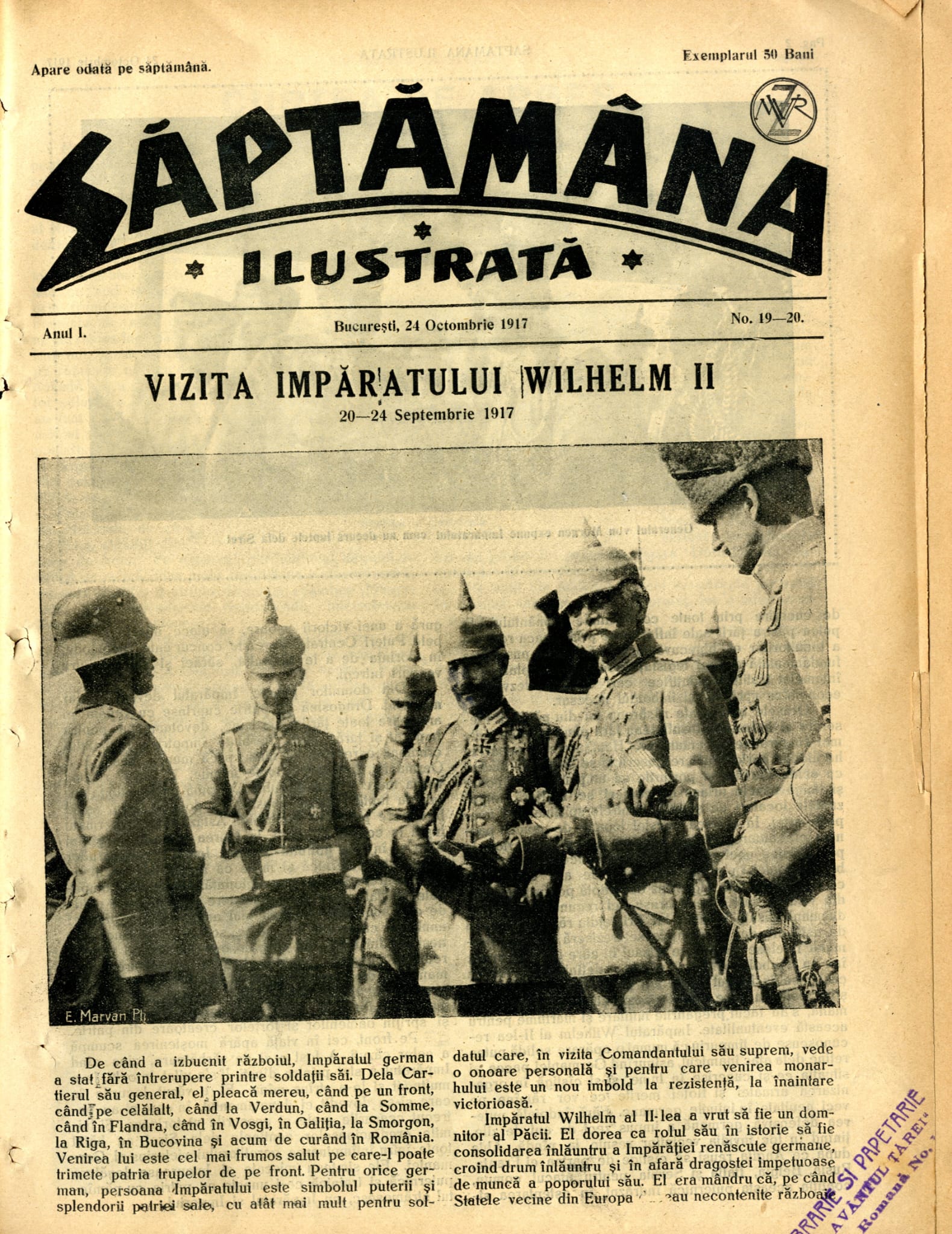
The year 1917 brought new challenges for the Romanian state, whose institutions found refuge in Iași. The implacable advance of the Germans was finally stopped by the bravery of the Romanian-Russian forces in the memorable confrontations at Mărăşti, Mărăşeşti, and Oituz in the summer of 1917. In this context, the inspection of the front by Wilhelm II, the Emperor of Germany, in the autumn of 1917, was prepared.[4] The former director of the Capital Police Prefecture, Anibal Stoenescu, reports that: “the frequent visits to the Police Prefecture by those from the German Command, as well as the secret conciliations of some of them with the Prefect, arouse my curiosity to the highest degree. The arrangements made for the beautiful house, the Florescu property, on Strada Victor Emanuel III, where expensive carpets and art objects from other houses have been brought, made me suspect that it was a visit by a high-ranking figure. And, indeed, in the end, the Prefect shares with me, under the greatest secrecy, the news of the Kaiser’s arrival for whom special preparations had been made to accommodate him in the presented building, as he was unwilling to stay in the Royal Palace, but at the last moment, the visit’s schedule changed, and he was no longer coming to Bucharest.”[5]
In another account of the time, the conservative politician who became a sacrificial prime minister on 5 March 1918, Alexandru Marghiloman, recalled in his Note Politice [Political Notes] the following: “Tzigara says that the Emperor is the kindest person he has ever met. You wouldn’t think that you are in front of a ʻMajestyʼ. He is well-informed, familiar with all aspects, and has a broad overview of matters. He admires the Romanian peasant. In everything, he was convinced of the superiority of our people over the Bulgarian people. The country seemed very beautiful to him; the position of the Curtea de Argeș, completely Western; nothing resembling the East. Twice he says: ʻHow could your King do what he did? Could it be lack of character or great stupidity? An impressionable nature and bad entourage,ʼ replies Tzigara.”[6]
“25 September – Official report on the Emperor’s journey in this morning’s newspapers.
In the city, people are uneasy about the presence of the Tsar of Bulgaria and his two sons, who have arrived in Cernavodă to greet the Emperor. This visit is considered a manifestation of Bulgaria’s claims towards Romania.
The Emperor pronounced harsh words in Focşani, before the troops, for the ʻunfaithful Hohenzollern, who, following a great Ruler endowed with noble qualities, did not want to know his traditions of fidelity.ʼ” [7]
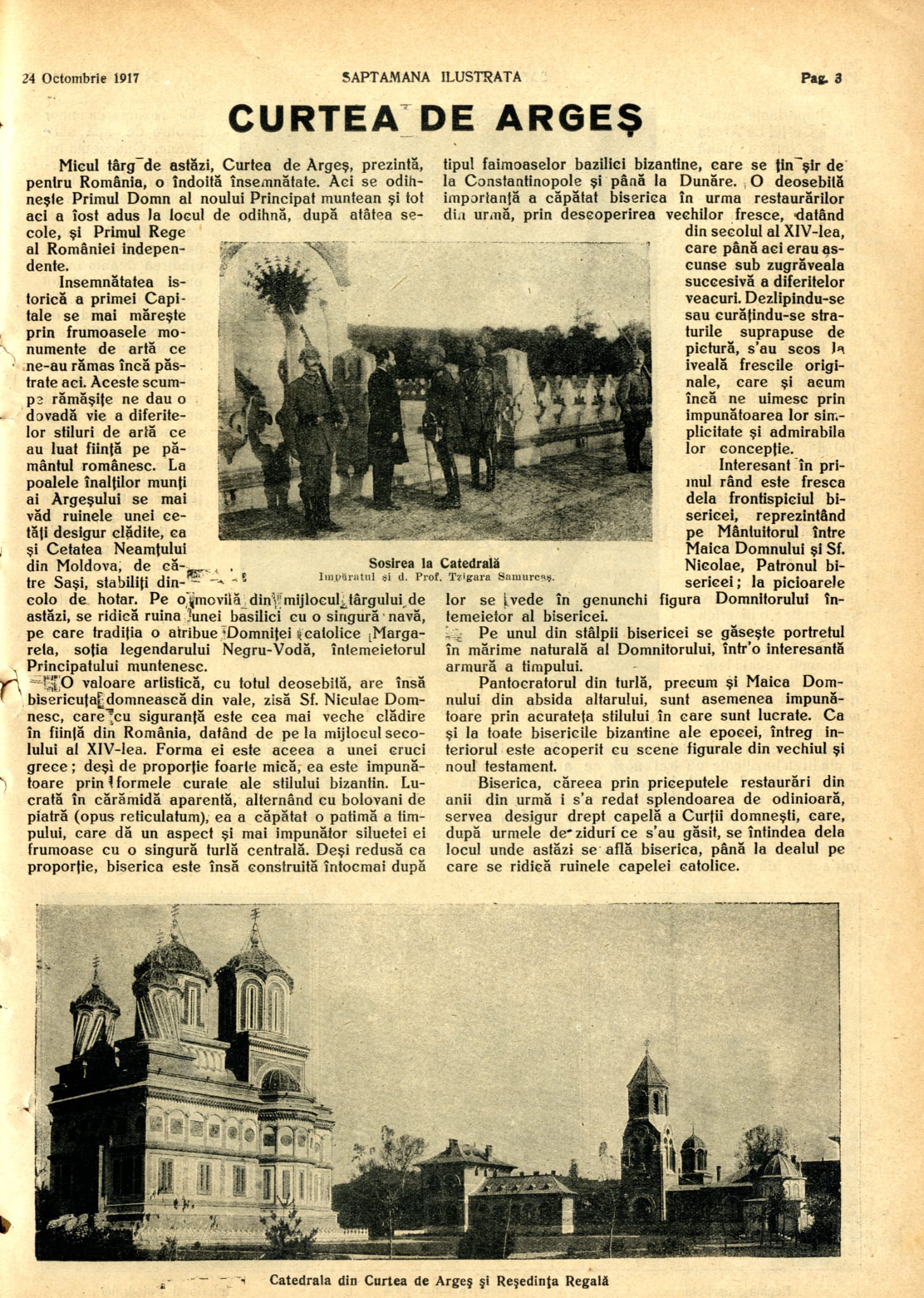
During the German occupation, King Ferdinand I appointed the university art historian Alexandru Tzigara-Samurcaş (1872-1952) to be the representative of the Royal House and the Crown Domains, and he was also appointed Prefect of the Capital Police by Lupu C. Kostaki (the guarantor of the Ministry of Internal Affairs for the period of military occupation). He managed to fulfil the assigned tasks in an exemplary manner, despite some controversies. And the fact that he spoke excellent German, coupled with his moral probity, earned him the trust of the occupation administration. Regarding the details of the meeting with Kaiser Wilhelm II, Tzigara-Samurcaş provides the following clarifications: “On 18 September 1917, Marshal Mackensen informed me with the utmost discretion that in two days the Kaiser would come to the Curtea de Argeș. He did not want to see any politician from the country. As a representative of the Royal House, however, I was called to accompany the Kaiser to the royal tombs, showing him the royal residence and the other artistic monuments. On this occasion, the Marshal asked me to reinstall in the Episcopal Church the gospel of Queen Elisabeth, which, for greater security, I had removed in October 1916.
Thursday, 20 Sept., in the afternoon, I arrived by the Marshal’s train at Argeş; I placed the gospel in its place, awaiting the visitors. The premises were deserted; no one except the sentries. […] The train of thought, full of worries about the outcome of the meeting, was interrupted by the automobile bringing the Kaiser, accompanied by the Marshal, to the entrance of the church. Extending my hand, the Kaiser expressed his regret for not having visited his cousin while he was alive and for finding himself now solely before graves. To the question, ʻHow was our war possible?ʼ, I replied that, as the entire nation desired it, it could not have been otherwise.
ʻBut King Carol would never have consented.ʼ
ʻDeath spared him from having to make that decision.ʼ
When the companions arrived, I entered the church. The Kaiser laid a wreath at the two royal tombs, holding a moment of silence. After explaining the gospel, the pictorial and architectural decoration of the church, we went to the residence, where we explained the fresco illustrating the legend of Manole.”[8]
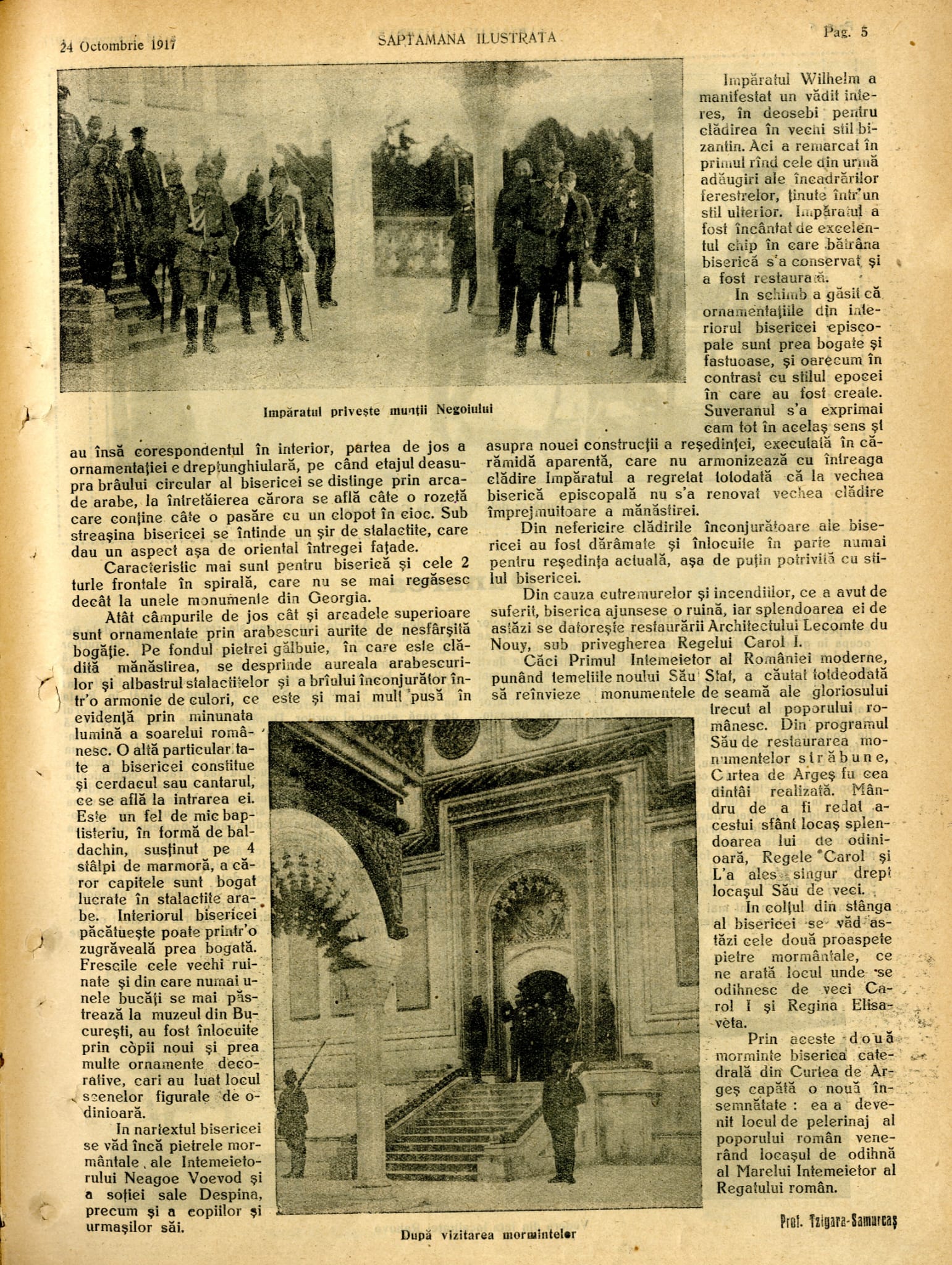
A lunch followed in a hall of the train station, during which Tzigara-Samurcaş spoke to Wilhelm II, among other things, about the ethnic and moral characteristics of the Romanian people, the wealth of the country, but also about the metopes of the monument at Adamclisi which supposedly represented the victory of the Roman legions over the ancient German tribes. Upon departure, the Emperor reportedly handed him, as a sign of gratitude, a box containing a tie pin.[9]
The next day, the German imperial delegation headed to Cernavodă where they were to meet with Tsar Ferdinand I of Bulgaria. Later, the Kaiser, having arrived near Focşani, inspected troops and forts, and in a symbolic gesture planted a German banner on the top of Măgura Odobeştilor at Cota 1001.[10]
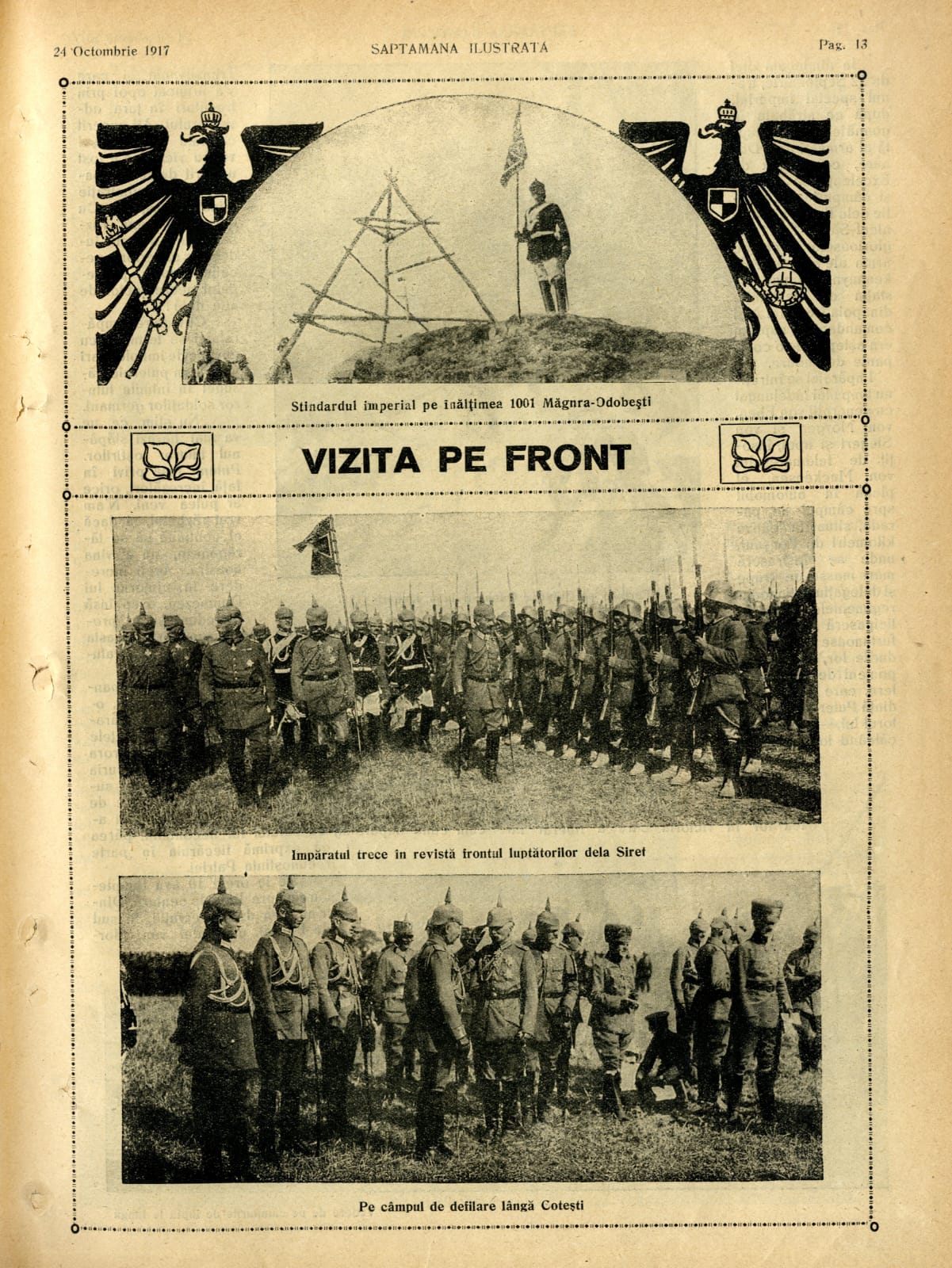
The next objectives of the visit were the salt mines at Slănic and the oil wells at Câmpina. The strategic resources located here were of major importance for the supply of the German armies, the war being won only through unhindered access for their exploitation. From here, having arrived at the Sinaia castle, Wilhelm II, together with his suite, spent the night in a carriage of the imperial train, then continuing his journey to Transylvania.[11]
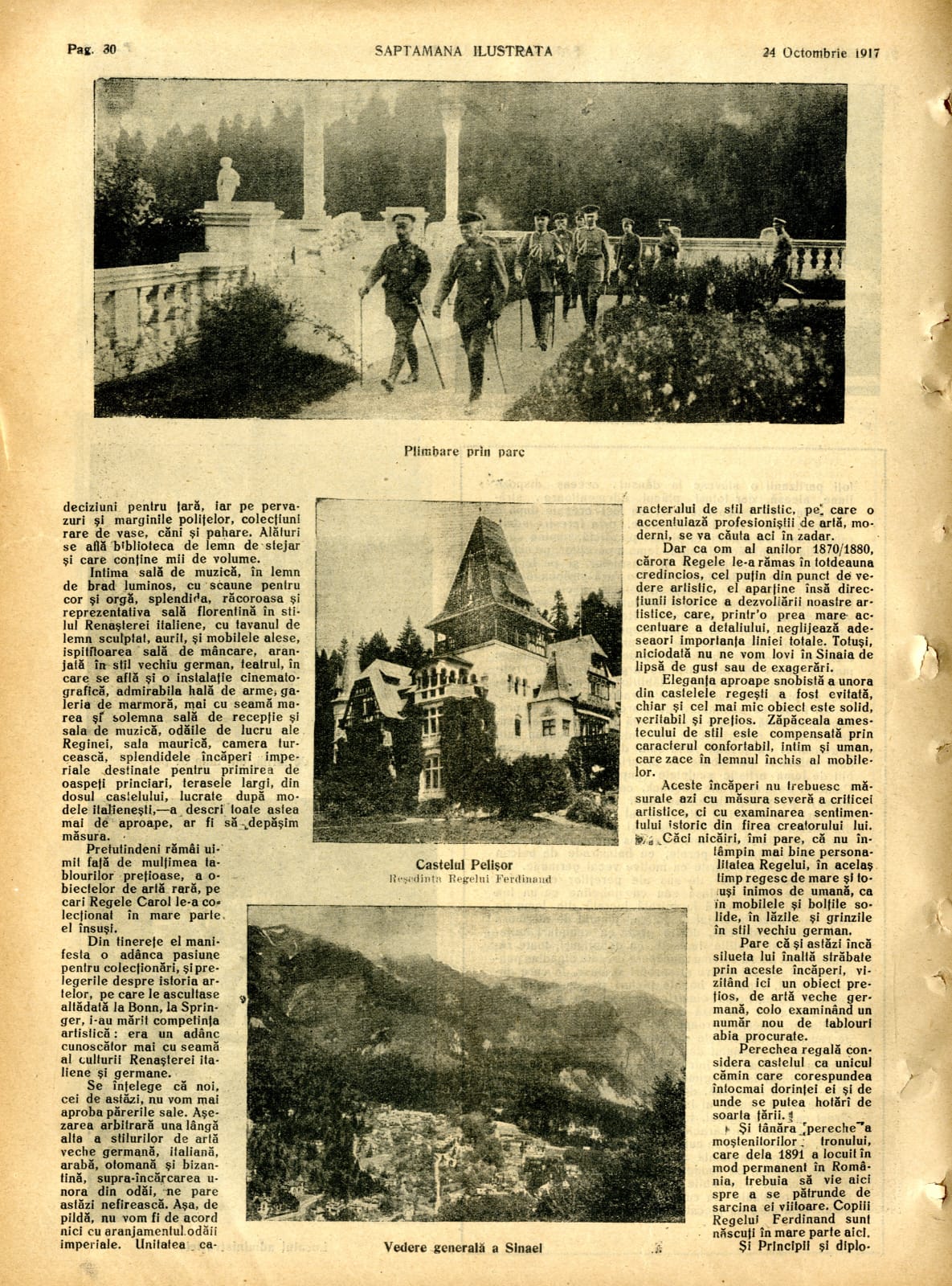
Being the only personality that Emperor Wilhelm II wished to meet confirms the high esteem that Alexandru Tzigara-Samurcaş enjoyed both nationally and internationally. The director of the “Carol I” University Foundation was not only a true founder of several cultural institutions, but also a remarkable scholar. Earnestness, intelligence, refined manners, integrity, and an extraordinary capacity for work were his hallmarks in every activity he took part in.
[1] Marc David Baer, Otomanii: Hani, Cezari şi Califi, ed. Humanitas, Bucureşti, 2023, p. 428.
[2] Ruxandra Bratu, „105 ani de la semnarea Tratatului de alianţă dintre România şi Antanta (4 august)”, Agerpres, https://agerpres.ro/documentare/2021/08/03/documentar-105-ani-de-la-semnarea-tratatului-de-alianta-dintre-romania-si-antanta-4-august–757960, 03-08-2021, link accesat în 25.02.2026.
[3] Alexandru Armă, Bucureştiul sub bombele germane (august-noiembrie 1916), ed. Vremea, Bucureşti, 2015, p. 123.
[4] Stelian Tănase, Mustăţile feldmareşalului Mackensen – antiroman: Bucureştii sub ocupaţie străină, 1916-1918, ed. Corint, Bucureşti, 2025, pp. 221-225.
[5] Anibal Stoenescu, Din vremea ocupaţiei 1916-1918, ed. Vremea, Bucureşti, 2024, p. 110.
[6] Alexandru Marghiloman, Note Politice 1917-1918, Vol. III, Paul Editions, Bucureşti, 2023, p. 73.
[7] Ibidem, p. 74.
[8] Alexandru Tzigara-Samurcaş, „Mărturisiri si-li-te”, Convorbiri Literare, Tipografia, Bucureşti, 1920, pp. 114-115.
[9] Ibidem, pp. 116-117.
[10] Ion Cristoiu, „Vizita împăratului Germaniei, Wilhelm al II-lea, în România ocupată”, Historia, nr. 189, octombrie 2017.
[11] Sabina Cantacuzino, Din viaţa familiei Ion C. Brătianu; 1914-1919, ed. Humanitas, Bucureşti, 2014, p. 145.